07. More Services
🛡️ 01. AWS Certificate Manager (ACM)
AWS Certificate Manager (ACM) provides and manages SSL/TLS certificates to enable HTTPS (in-flight encryption) for AWS resources.
| Feature | Description |
|---|---|
| Purpose | Secure communication between users and apps using HTTPS |
| Free Public Certs | Public certificates are free and auto-renewed |
| Private Certs | For internal apps via AWS Private CA |
| Integration | Works with ALB, CloudFront, API Gateway, etc. |
| Validation | Domain ownership verified via DNS or email |
| Automation | ACM handles provisioning, renewal, and deployment |
🔧 How It Works
- Request a certificate in ACM (public or private).
- Validate domain ownership.
- Attach to AWS resources (e.g., ALB, CloudFront, API Gateway).
- ACM auto-renews certificates before expiry.
💡 Exam Tip
If a question mentions HTTPS, SSL/TLS certificate, or in-flight encryption,
the answer is AWS Certificate Manager (ACM).
🔐 02. AWS Secrets Manager
AWS Secrets Manager securely stores, retrieves, and automatically rotates secrets like database passwords or API keys.
- Stores secrets securely (DB creds, API keys, etc.)
- Auto-rotation using Lambda (e.g., every 30 or 90 days)
- Integrates with Amazon RDS (MySQL, PostgreSQL, Aurora)
- Encrypted using AWS KMS
- Access via SDK, CLI, or Console
- Paid service – $0.40 per secret/month (+ API costs)
💡 Notes
- Removes hardcoded credentials in apps
- For non-sensitive configs, use SSM Parameter Store instead
- Exam tip → For RDS password rotation, answer is Secrets Manager
📄 03. AWS Artifact
AWS Artifact is a portal (not an actual service) that provides on-demand access to AWS compliance reports and agreements.
- Not a service, but a self-service compliance portal.
- Provides access to security and compliance documents.
- Useful for audits and regulatory compliance.
🧩 Two Main Components
| Component | Description |
|---|---|
| Artifact Reports | Download AWS compliance and security reports (e.g., ISO, PCI, SOC). |
| Artifact Agreements | Review, accept, and track AWS legal agreements like BAA (Business Associate Addendum) and HIPAA. |
💡 Use Case
- Supports internal audit and compliance reviews.
- Demonstrates that workloads hosted on AWS meet industry standards.
- Accessible globally via the AWS Console → Artifact.
📘 Remember:
AWS Artifact = Compliance Reports + Agreements portal (ISO, PCI, SOC, HIPAA, BAA).
🛡️ 04. Amazon GuardDuty
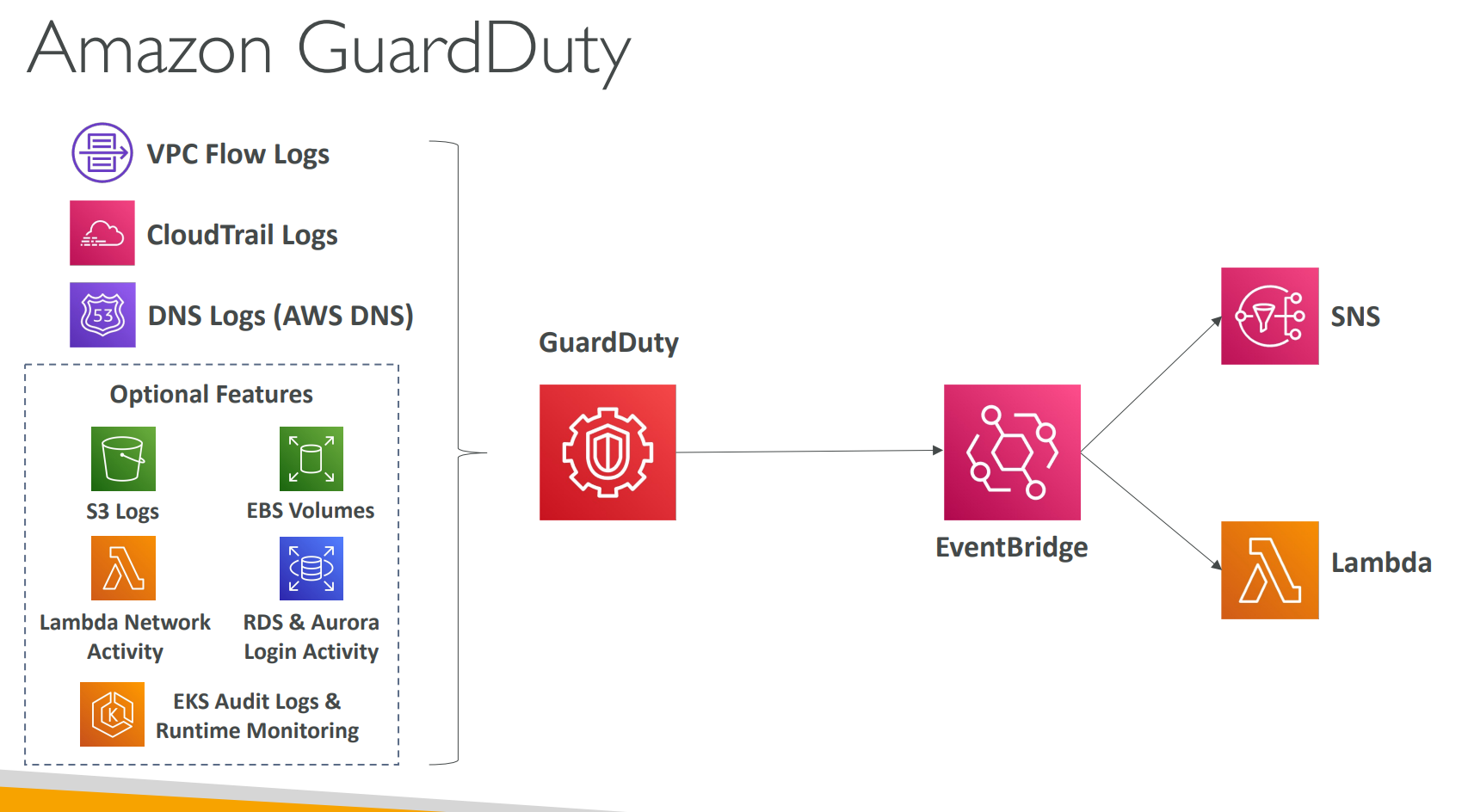
Amazon GuardDuty is a threat detection service that continuously monitors your AWS accounts, workloads, and data stored in S3 for malicious activity and unauthorized behavior.
| Feature | Description |
|---|---|
| Intelligent Threat Detection | Uses machine learning, anomaly detection, and integrated threat intelligence to identify potential security risks. |
| No Setup Overhead | Enabled with one click, no agents or software installation required. Includes a 30-day free trial. |
| Continuous Monitoring | Continuously analyzes multiple AWS data sources for suspicious activity. |
📊 Data Sources Analyzed
| Category | Examples |
|---|---|
| Core Sources | - VPC Flow Logs → Detect unusual IPs or network traffic patterns. - AWS CloudTrail Logs → Identify unusual API calls or unauthorized deployments. - DNS Logs → Detect encoded data exfiltration via DNS queries. |
| Optional Sources | - S3 Data Events (GetObject, DeleteObject, etc.) - EBS Volumes (malware scanning) - RDS/Aurora Login Events - EKS Audit & Runtime Logs - Lambda Network Activity |
⚙️ Integration & Automation
| Component | Purpose |
|---|---|
| Amazon EventBridge | Receives GuardDuty findings as events. |
| Automation | Create EventBridge rules to trigger: - Lambda functions (auto-remediation) - SNS notifications (alerts) |
| Use Cases | - Auto-isolate compromised EC2 instances - Notify SecOps teams of suspicious actions |
💰 Common GuardDuty Findings
| Type | Example |
|---|---|
| Credential Compromise | Unusual API activity in CloudTrail |
| Network Threats | Port scanning, brute-force attempts |
| Malware / Crypto Attacks | GuardDuty detects cryptocurrency mining indicators |
| Data Exfiltration | DNS tunneling, unauthorized S3 data access |
🧠 Summary
- Amazon GuardDuty provides intelligent, continuous threat detection using multiple AWS log sources.
- Findings are sent to EventBridge → can trigger Lambda or SNS for response automation.
- Helps protect against unauthorized activity, data theft, and crypto-mining attacks.
🧩 05. Amazon Inspector
Amazon Inspector is an automated vulnerability management service that continuously scans AWS workloads for software vulnerabilities and unintended network exposure.
| Capability | Description |
|---|---|
| Automated Scanning | Continuously assesses resources without manual intervention. |
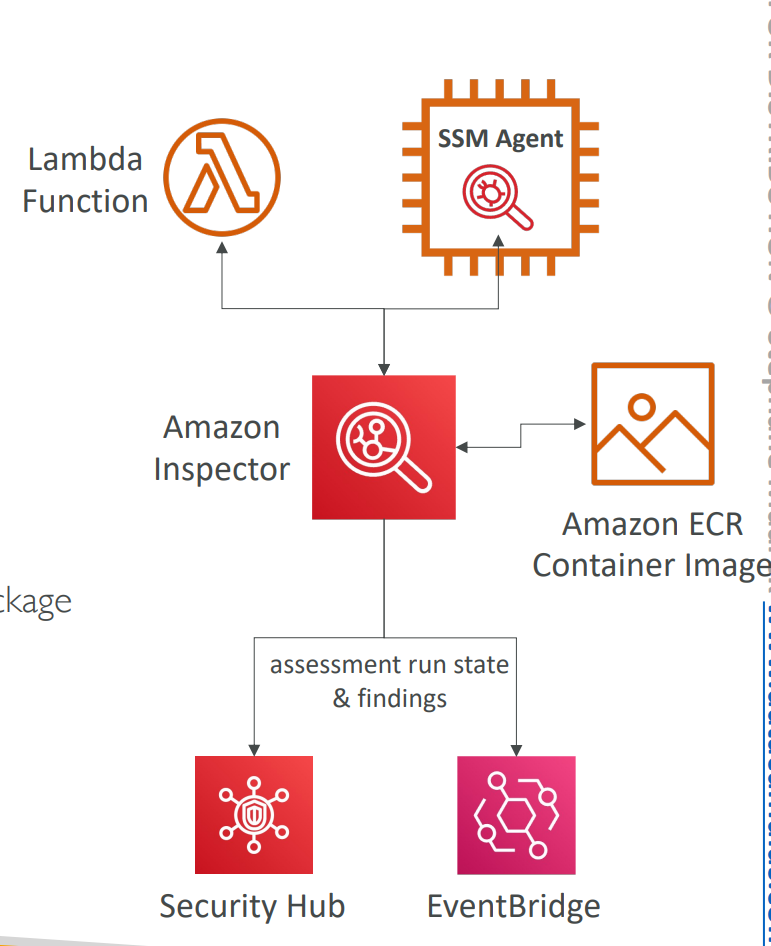
| Agent-Based for EC2 | Uses AWS Systems Manager (SSM) Agent on EC2 instances to evaluate vulnerabilities and network reachability. |
| Integrated with ECR & Lambda | Automatically scans container images in Amazon ECR and Lambda functions during deployment. |
| Continuous Updates | Automatically rescans when the CVE database is updated. |
⚙️ Components & Scope
| Resource Type | What It Scans | Assessment Criteria |
|---|---|---|
| EC2 Instances | OS packages and network configuration | Known vulnerabilities (CVE), unintended network access |
| ECR Container Images | Pushed Docker images | Software vulnerabilities (CVE database) |
| Lambda Functions | Function code and dependencies | Software/package vulnerabilities |
🧠 How It Works
- Enable Inspector in the AWS Management Console.
- It automatically discovers eligible EC2, ECR, and Lambda resources.
- Scans them continuously against:
- Known CVEs (Common Vulnerabilities and Exposures)
- Network Reachability (for EC2 only)
- Generates findings with risk scores for prioritization.
📊 Findings & Integrations
| Integration | Purpose |
|---|---|
| AWS Security Hub | Centralized view of all vulnerability findings. |
| Amazon EventBridge | Event-driven automation on new findings (e.g., notify via SNS, trigger Lambda). |
| Risk Scoring | Assigns severity levels to vulnerabilities for remediation prioritization. |
💡 Example Use Cases
- Identify outdated OS packages or open ports on EC2 instances.
- Detect vulnerabilities in container base images before deployment.
- Scan Lambda functions for insecure dependencies.
- Automate remediation through EventBridge → Lambda workflows.
🧩 Summary
- Amazon Inspector continuously evaluates EC2, ECR, and Lambda for vulnerabilities and exposure.
- Uses CVE databases and network reachability analysis.
- Findings flow into Security Hub and EventBridge for visibility and automation.
- Helps maintain a proactive security posture across AWS workloads.
🧩 06. AWS Config
AWS Config is a service that helps you audit, record, and evaluate the configurations of your AWS resources over time.
🧭 What AWS Config Does
| Feature | Description |
|---|---|
| Configuration Recording | Tracks configuration changes of AWS resources (e.g., EC2, S3, IAM). |
| Compliance Auditing | Checks if resources comply with internal or regulatory standards. |
| Change History | Maintains a timeline of configuration changes for each resource. |
| Data Storage | Stores configuration snapshots in Amazon S3, which can be analyzed using Athena. |
| Notifications | Sends SNS alerts when resource configurations change. |
| Integration | Works with AWS CloudTrail to show who made API calls. |
🧠 Example Questions AWS Config Can Answer
- ❓ Is there unrestricted SSH access in my security groups?
- ❓ Are any of my S3 buckets publicly accessible?
- ❓ How has my Application Load Balancer configuration changed over time?
🌍 Key Points
- AWS Config is a per-region service.
- You can aggregate configuration data across multiple regions and accounts.
- You can view resource compliance and configuration history at any time.
📊 Use Case Example
| Task | AWS Config Feature Used |
|---|---|
| Track changes to EC2 instances | Configuration Recorder |
| Identify non-compliant resources | Config Rules |
| Notify when changes occur | SNS Integration |
| Analyze historical configurations | S3 + Athena |
In short:
🧩 AWS Config continuously records resource configurations, checks for compliance, and alerts you about changes — helping maintain visibility and governance across your AWS environment.
🔍 07. Amazon Macie
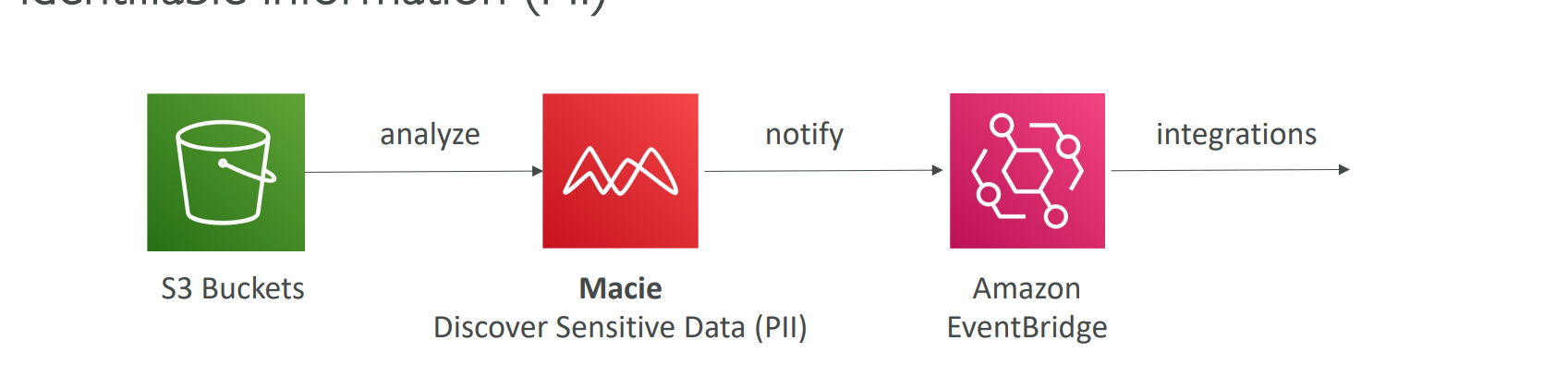
Amazon Macie is a fully managed data security and privacy service that uses machine learning (ML) and pattern matching to automatically discover, classify, and protect sensitive data stored in AWS.
🧠 What Macie Does
| Feature | Description |
|---|---|
| Data Discovery | Scans and identifies sensitive data (e.g., PII, financial data) in your Amazon S3 buckets. |
| Machine Learning & Pattern Matching | Uses ML models to detect patterns such as credit card numbers, API keys, and personal data. |
| Automated Classification | Classifies and labels S3 objects containing sensitive data. |
| Security Alerts | Generates findings and sends alerts for any exposure or risk detected. |
| Data Visibility | Provides a centralized dashboard to view where sensitive data is located and how it’s being accessed. |
🧩 Common Use Cases
- 🔐 Identify PII (Personally Identifiable Information) across S3 buckets.
- ⚠️ Detect unintended data exposure or publicly accessible sensitive data.
- 🧾 Support compliance with standards like GDPR, HIPAA, or PCI-DSS.
- 📊 Monitor data security posture over time.
🌍 Key Points
- Fully managed service — no need to maintain infrastructure.
- Analyzes only S3 data at present.
- Integrates with Amazon EventBridge, AWS Security Hub, and SNS for alerting and automation.
- Helps maintain data privacy and compliance across your AWS environment.
In short:
🔍 Amazon Macie uses AI-powered scanning to automatically find, classify, and protect sensitive data like PII in your S3 buckets — keeping your AWS environment secure and compliant.
🛡️ 08. AWS Security Hub
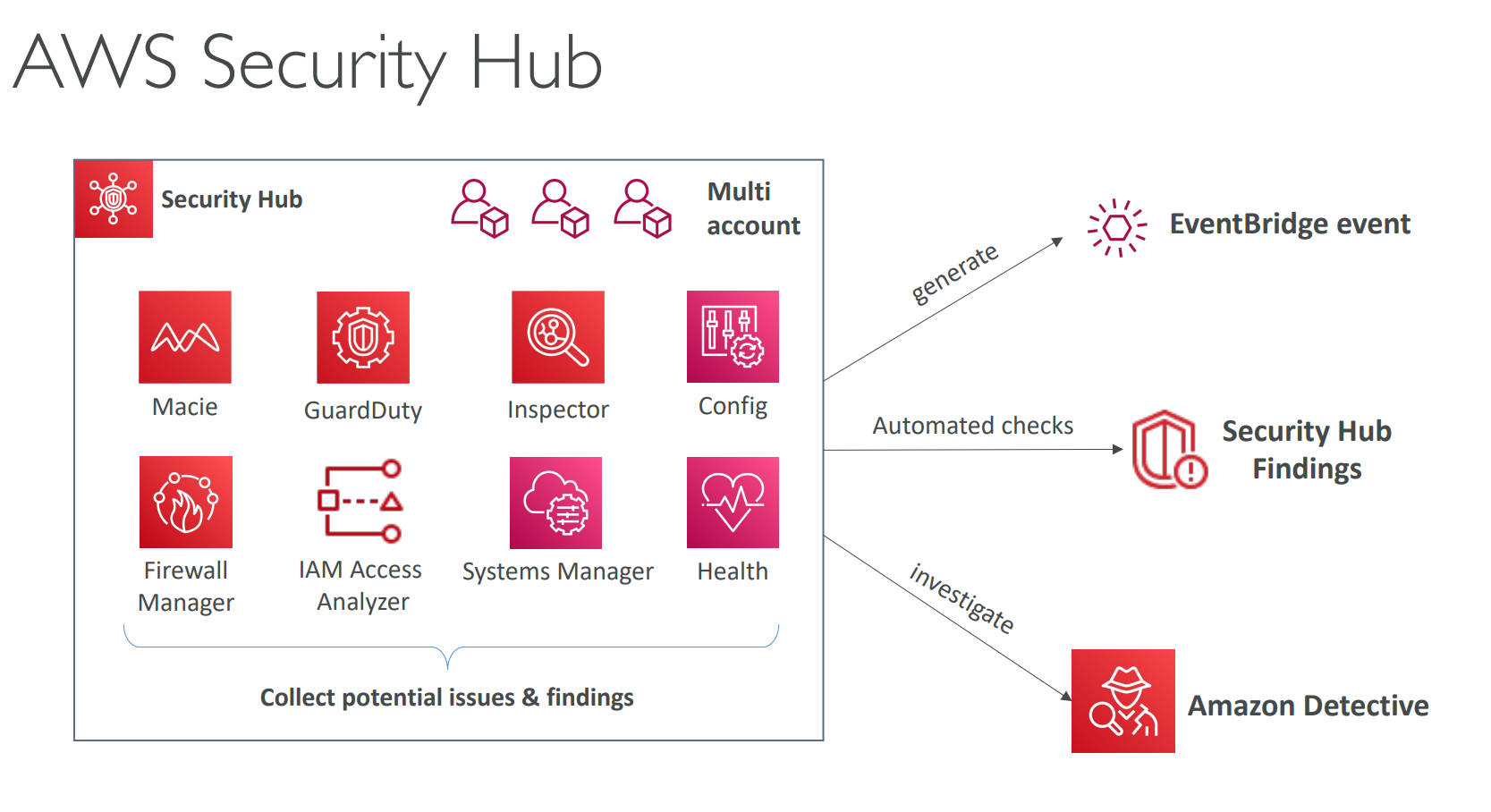
AWS Security Hub is a centralized security and compliance service that helps you analyze, manage, and automate security checks across multiple AWS accounts and regions.
🧭 What Security Hub Does
| Feature | Description |
|---|---|
| Centralized Dashboard | Provides a unified view of your AWS security posture and compliance status. |
| Automated Security Checks | Continuously evaluates your AWS environment against security standards like CIS AWS Foundations and PCI DSS. |
| Findings Aggregation | Collects and normalizes alerts (called findings) from multiple AWS services and partner tools. |
| Multi-Account Management | Supports AWS Organizations for centralized security visibility across all accounts. |
| Integration & Automation | Integrates with AWS services and third-party tools for alerting, remediation, and workflow automation. |
🧩 Integrated AWS Services
Security Hub aggregates findings from:
| Source Service | Purpose |
|---|---|
| AWS Config | Compliance and configuration tracking (must be enabled first) |
| Amazon GuardDuty | Threat detection and anomaly analysis |
| Amazon Inspector | Vulnerability assessment |
| Amazon Macie | Sensitive data discovery |
| IAM Access Analyzer | Identifies risky permissions |
| AWS Systems Manager | Operational insights |
| AWS Firewall Manager | Network and firewall compliance |
| AWS Health | AWS account and resource health events |
| AWS Partner Tools | Security and compliance integrations |
⚙️ Example Capabilities
- 📊 View compliance status in a single dashboard.
- ⚠️ Detect misconfigurations or vulnerabilities across accounts.
- 🔄 Automate response actions via EventBridge or Lambda.
- 🧾 Generate consolidated reports for audits and compliance reviews.
🌍 Key Points
- Requires AWS Config to be enabled.
- Aggregates data across multiple accounts and regions.
- Supports custom insights and automated workflows for remediation.
In short:
🛡️ AWS Security Hub acts as the command center for your cloud security — unifying findings from AWS and partner services to give you complete visibility, compliance insights, and automated threat response.
🕵️♂️ 09. Amazon Detective
Amazon Detective is a security analysis and investigation service that helps you analyze, visualize, and identify the root cause of security issues or suspicious activities across your AWS environment.
🧠 What Amazon Detective Does
| Feature | Description |
|---|---|
| Deeper Investigation | Helps you investigate findings from GuardDuty, Macie, and Security Hub to determine the true cause and impact. |
| Automated Data Collection | Continuously ingests and processes data from VPC Flow Logs, AWS CloudTrail, and Amazon GuardDuty. |
| Graph-Based Analysis | Uses machine learning (ML) and graph models to connect and analyze related events and entities. |
| Unified View | Combines events, activities, and relationships across AWS accounts into a single interactive interface. |
| Visual Context | Generates visualizations to understand the “who, what, when, and where” behind each incident. |
🧩 Example Use Cases
- 🔎 Investigate suspicious API calls or unusual user behavior.
- 🧾 Trace the source of an attack or data exfiltration attempt.
- 🧠 Identify affected resources and related activities during a breach.
- ⚙️ Speed up incident response by providing contextual insights.
🌍 How It Works
- Findings Identified: GuardDuty, Macie, or Security Hub detect a potential issue.
- Data Collected: Detective automatically pulls in related logs and metrics.
- Graph Analysis: It builds an entity graph linking users, IPs, resources, and actions.
- Root Cause Visualization: You can explore interactive visual reports to pinpoint the cause.
⚙️ Key Integrations
| Integrated Source | Data Type |
|---|---|
| VPC Flow Logs | Network traffic patterns |
| AWS CloudTrail | API call and user activity history |
| Amazon GuardDuty | Security findings and threat indicators |
In short:
🕵️♂️ Amazon Detective helps you quickly investigate and visualize security incidents — turning raw logs into meaningful insights that reveal the root cause and context behind suspicious activity.
`
🚨 10. AWS Abuse
AWS Abuse is the official channel for reporting abusive, malicious, or illegal activities originating from AWS resources or IP addresses.
🧠 Purpose
AWS provides the Abuse Reporting Service to help individuals or organizations report cases where AWS infrastructure is being misused — whether intentionally or unintentionally — to perform harmful or prohibited actions.
🚫 Common Types of Abuse
| Type | Description |
|---|---|
| Spam | Receiving unwanted or unsolicited emails from AWS-owned IPs, or websites hosted on AWS sending spam messages. |
| Port Scanning | AWS resources sending packets to discover open or unsecured network ports. |
| DoS / DDoS Attacks | AWS IPs attempting to flood, crash, or overwhelm your applications or servers. |
| Intrusion Attempts | Unauthorized login or hacking attempts on your systems. |
| Hosting Illegal or Copyrighted Content | Distribution of pirated, copyrighted, or objectionable material without consent. |
| Malware Distribution | AWS resources being used to spread malicious software designed to harm computers or networks. |
🧩 How to Report Abuse
If you suspect AWS infrastructure is being used abusively:
| Reporting Method | Description |
|---|---|
| AWS Abuse Form | Submit an online report through the official AWS Abuse portal. |
| Send details to 📧 abuse@amazonaws.com including: - Source IP address - Time and date (with timezone) - Nature of the abuse - Relevant logs or evidence |
In short:
🚨 AWS Abuse is your go-to channel for reporting any malicious, abusive, or illegal behavior originating from AWS infrastructure — helping maintain a secure and trustworthy cloud ecosystem.